
The photographer Nona Faustine passed away on March 20th. She leaves behind her beautiful teen daughter and her sister, who was also her creative director. I got to meet Nona in 2015, when I reached out to her asking if she would consider being in an art exhibition I was curating. This would be my first show, and Nona was the first artist I spoke with. We met at her apartment in Flatbush, Brooklyn, a multigenerational home where Nona was raised and where she was raising her daughter. We spoke about histories hiding in plain sight throughout New York and the book Slavery by Another Name by Douglass Blackmon.
I had dressed cute for the occasion and recall being nervous, my vintage sweater making me sweat, and loving the way Nona had with telling a story. She knew when and how to lean in and pull back, to pause and let tough truths settle. And she was kind about teaching white people who are totally ignorant of the role all white people play upholding white supremacy. Through the gifts of storytelling, both orally and through photography, she was an educator for the ages. When she agreed to be in Exploring Human Injustices through Art, I knew my first exhibition was going to be a major life event for me.
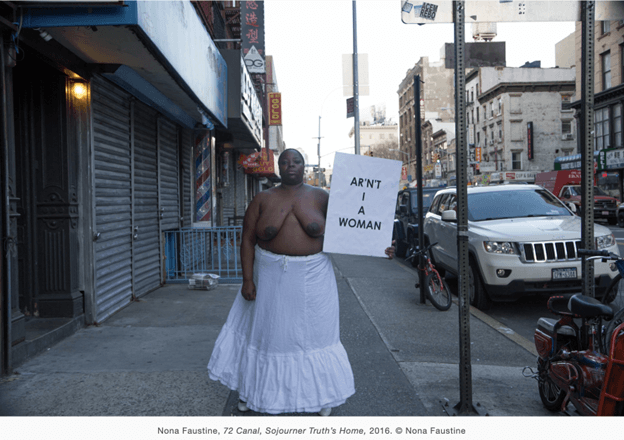
layered into her photographs was inspiring. The photograph above 72 Canal, Sojourner Truth’s Home, a part of her White Shoes series, was taken at the site as it appeared in 2016, when the photograph was taken. Canal Street, named for the man-made canals installed by the Dutch when the land was known as New Amsterdam, was a major thoroughfare when Truth would have lived there. The plaque in the photograph references a famous line from one of Truth’s speeches, given in 1851. I see the gaze of the character Nona is playing, and it is strong and proud. The woman we have been following through New York’s history of slavery has liberated herself. She celebrates leisure and knowledge and the land. Watching the evolution of the White Shoes has been a gift that will continue to grow.