
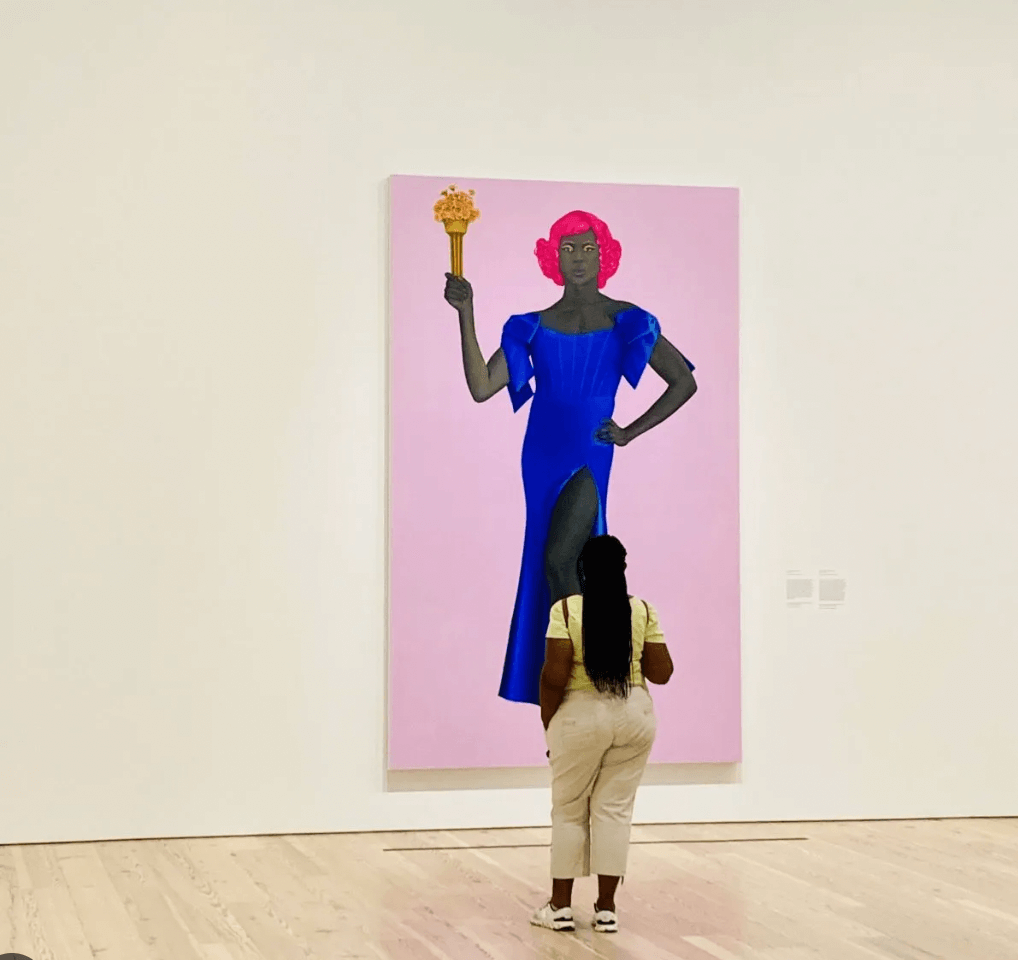
On July 24th The Guardian revealed that the American portrait artist Amy Sherald would be pulling her exhibition American Sublime from the Smithsonian National Portrait Gallery. The museum asked her to pull one of her paintings, Trans Forming Liberty, a painting of a trans woman in a blue corseted column dress holding a torch of flowers high above her pink-wig-wearing head. The artist and the court of public opinion called it censorship, blaming anti-trans legislation by the Trump 2.0 administration.
Then on August 12th, The White House issued a letter to the Smithsonian telling them that some of the language in the exhibitions needed to be reviewed due to the negative perceptions in some of the language, specifically targeting the National Museum of African American History and Culture. The letter states “it would begin a comprehensive look at current and planned exhibitions, wall text and social media to assess “tone, historical framing and alignment with American ideals” (www.nytimes.com). Director Lonnie Bunch has promised to uphold facts and truth despite the pushback.
Rewriting history through arts and culture is definitely in line with authoritarianism. We have seen it many times before: the Nazi Holocaust, the Khmer Rouge regime, and Pinochet’s vision for Chile. It is for this reason that dissent is educating one’s self despite these attacks on our First Amendment rights. Author Clint Smith wrote about the thread of history that was rewritten, especially in the wake of the Civil War through the early twentieth century when Black Americans enlisted to fight in World War I. These two periods in history have been cast as too shameful for white people to acknowledge. When stories are silenced in this way, it makes room for revisionist history. In the United States revisionist history was spearheaded by the United Daughters of the Confederacy and the Daughters of the American Revolution. These organizations thrived in the periods between Reconstruction and World War II, having monuments erected to consecrate what they were espousing American.
Smith’s book How the Word is Passed traces the erection and celebration of monuments and landmarks that rewrote history. Educating readers through the historical lens of monuments, Smith provides examples of misseducation (Monticello, the plantation of Thomas Jefferson), and re-education, (The Whitney Plantation). The calls to review so-called sensitive materials that place slavery in a negative light and to amplify achievements in history is clearly a manipulation of power.
The White House is manifesting The Prince from Machiavelli’s book, considered a treatise when it was published in 1532 for up-and-coming royalty. The book justified violence as a mechanism of revenge and silencing. Currently violence and threats are playing out in the United States, and voices, especially of Black and Brown people, are being silenced. It is a trial. The Prince was a prestidigitator, planting seeds of trickery and revenge in the mind. In real life a counter measure to this level of chicanery is self-education through arts and culture. When we know our history, both good and bad, we have a base through which to perceive the world around us.
A few books that challenge ways of seeing art and the historical narratives that contextualize art by Black creatives.
A Black Gaze: Artists Changing How We See by Tina M. Campt
‘Race Is Everything’: Art and Human Difference by David Bindman
With a Foreword by Henry Louis Gates Jr.
Art on My Mind: Visual Politics by bell hooks